In This Article (17)
The Short Answer
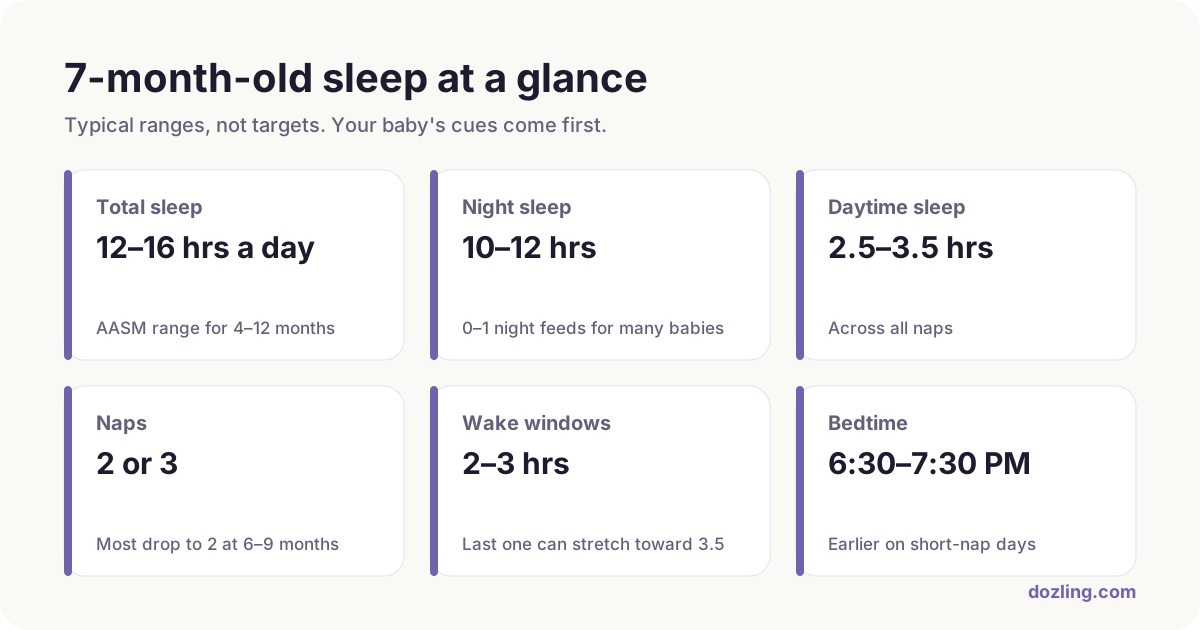
A 7-month-old usually stays awake for 2 to 3 hours between sleeps, takes 2 or 3 naps, and sleeps about 2.5 to 3.5 hours in total during the day. Night sleep is often around 10 to 12 hours. The American Academy of Sleep Medicine consensus, endorsed by the AAP, recommends 12 to 16 hours of total sleep per 24 hours, including naps, for babies aged 4 to 12 months.
These are ranges, not targets. For every age from birth to 24 months, see our wake windows by age chart and the full baby sleep schedule by age.
Wake Windows Through the Day
At this age the windows usually get longer as the day goes on:
| Time of day | Typical wake window | What to watch for |
|---|---|---|
| First window after the morning wake-up | 2–2.5 hrs | A first nap that starts too early can lead to early morning waking |
| Midday window | 2.5–3 hrs | Often the window that stretches first during the move to two naps |
| Last window before bedtime | 2.5–3 hrs (up to about 3.5 on two naps) | Shorter after a short last nap or a skipped third nap |
Babies who still take three naps usually do best at the lower end of these ranges. Babies on two naps often manage close to 3 hours by the end of the day. After a short nap, start watching for sleepy cues earlier rather than waiting for the clock.
What Changes Around 7 Months
Several things tend to shift at once, which is why sleep can feel unpredictable this month:
- Movement. Many babies sit steadily, start to crawl or creep, and some try to pull up. In a study of 107 babies aged 5 to 8 months, Scher and Cohen (2005) found that babies who were already crawling had more bedtime difficulties and night waking than babies who were not yet crawling. That is an association, not proof that every waking comes from a new skill.
- The move to two naps. The third nap often becomes short, hard to fit in, or late enough to push bedtime back.
- Early separation anxiety. Some babies start protesting when a parent leaves the room, at bedtime as well as during the day.
- Solid food. Most babies have started solids by now. Food changes the shape of the day, but it is not a sleep tool: in a randomized study of 106 infants, Macknin and colleagues (1989) found that rice cereal in the bedtime bottle made no consistent difference to sleeping through the night. Cereal in a bottle is not recommended unless your pediatrician advises it.
Sample 7 Month Old Sleep Schedules
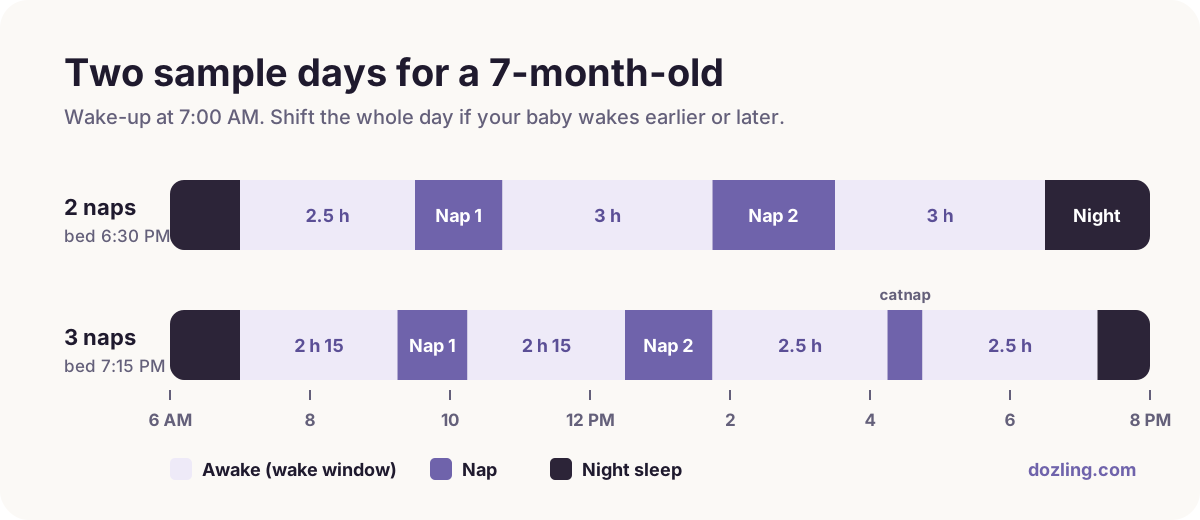
Two versions follow. Shift the whole day if your baby wakes earlier or later than 7:00 AM; the length of the windows matters more than the clock.
2-Nap Schedule
- 7:00 AM — Wake up, milk feed
- 9:30–10:45 AM — Nap 1 (wake window: 2.5 hrs)
- 1:45–3:30 PM — Nap 2 (wake window: 3 hrs)
- 6:10 PM — Bedtime routine
- 6:30 PM — Asleep for the night (wake window: 3 hrs)
Daytime sleep: about 3 hours. This version suits babies who sleep at least an hour per nap and can stay happily awake for close to 3 hours.
3-Nap Schedule
- 7:00 AM — Wake up, milk feed
- 9:15–10:15 AM — Nap 1 (wake window: 2 hrs 15 min)
- 12:30–1:45 PM — Nap 2 (wake window: 2 hrs 15 min)
- 4:15–4:45 PM — Nap 3, a short catnap (wake window: 2.5 hrs)
- 6:55 PM — Bedtime routine
- 7:15 PM — Asleep for the night (wake window: 2.5 hrs)
Daytime sleep: about 2 hours 45 minutes. This version suits babies whose naps are still on the shorter side.
Milk feeds and solid meals fit around these sleep times. Many families offer solids after a nap rather than right before one, when a tired baby is less interested in eating.
How Long Should Naps Be?
On a two-nap day, each nap often lasts somewhere between 1 and 2 hours, adding up to roughly 2.5 to 3.5 hours of daytime sleep. On a three-nap day, the first two naps are often around an hour and the third is a short catnap of 20 to 45 minutes that simply bridges the gap to bedtime.
Naps of 30 to 45 minutes are still common at 7 months, especially for babies who are just learning to link sleep cycles during the day. If your baby wakes happy and copes well until the next sleep, short naps are not a problem to fix. If they wake upset and tired, try a darker room, a short pause before you go in, and starting the nap a little earlier. Our guide to babies who only nap 30 minutes goes into more detail.
Two Naps or Three?
Both are normal at 7 months. Nap length usually decides:
- Two solid naps of 1 to 2 hours each: two naps are often enough, with an earlier bedtime.
- Shorter naps of 30 to 60 minutes: most babies still need a third nap, often a short late-afternoon catnap.
- A bit of both: completely normal during the transition. Many babies go back and forth between two and three naps for a week or two.
Signs Your Baby Is Ready for Two Naps
Change the schedule only when several of these repeat for a week or more:
- the third nap often does not happen, or takes a long time to fall asleep for,
- the third nap pushes bedtime past 8:00 PM,
- the first two naps are solid and your baby wakes from them rested,
- your baby stays happily awake for close to 3 hours.
To make the move, stretch the wake windows gradually rather than all at once, and move bedtime earlier, even to around 6:00 to 6:30 PM, for the first week or two. Our guide to nap transitions by age covers this transition and the ones that follow.
Night Sleep at 7 Months
Many 7-month-olds sleep around 10 to 12 hours at night. Some no longer need a night feed and others still have one, so talk to your pediatrician before you drop night feeds.
New night waking is common at this age. Before you change anything, check the usual suspects:
- A new skill: sitting or crawling practice can wake a baby, or keep them busy instead of settling.
- Separation anxiety: a calm, predictable goodnight and a quick, boring check-in usually work better than long negotiations. See our guide to separation anxiety and sleep.
- Teething or illness: a few rough nights around a new tooth are common; fever is not a typical teething sign. Our teething and sleep guide has more.
- The schedule: a last wake window that is too long, or a third nap that ends too close to bedtime.
If night waking starts suddenly and lasts several weeks, it may be what many parents call the 8 month sleep regression arriving a little early. Our guide to the 8, 12 and 18 month sleep regressions explains what helps.
Is There a 7 Month Sleep Regression?
There is no well-defined "7 month sleep regression" in the research. What many families notice at this age is a mix of the changes above: new movement, the move to two naps, and the first signs of separation anxiety. For some babies, the unsettled stretch that parents call the 8 month regression simply starts a few weeks early.
The approach is the same either way: keep wake windows that fit your baby, keep the bedtime routine, give plenty of floor time for new skills, and avoid starting new habits you would not want to keep. Most of these patches settle within a few weeks.
Early Morning Waking
Waking before 6:00 AM is a frequent complaint around this age. A few things are worth checking:
- Darkness. Early morning light through the curtains can wake a baby in lighter morning sleep.
- A first nap that starts too early. If the first nap begins less than about 2 hours after waking, the early wake-up can become a habit.
- Bedtime that is too late or too early. Both an overtired baby and one with too little sleep pressure can wake early.
- A calm, boring response. Treat a 5:00 AM waking like a night waking, and start the day at a more reasonable time if you can.
A Bedtime Routine That Works at 7 Months
A short, predictable routine helps more than any single trick. In a randomized study of 405 mothers and their babies and toddlers aged 7 to 36 months, Mindell and colleagues (2009) found that a consistent nightly routine cut the time to fall asleep and reduced night waking within two weeks.
At 7 months, 20 to 30 minutes is plenty. A typical order is a bath (it does not have to be every night), pajamas and a sleep sack, a milk feed, a short book, a song, and into the crib. Keep the order the same each night, and use a two-minute version of it before naps. Our baby bedtime routine by age has ideas for each stage.
Can You Sleep Train at 7 Months?
You do not have to. Plenty of families never do any formal sleep training, and that is a valid choice. If night waking or long bedtimes are wearing your family down, though, 7 months is an age at which many families start, and the research is reassuring:
- In a randomized trial of 43 infants aged 6 to 16 months, Gradisar and colleagues (2016) found that graduated extinction and bedtime fading both improved sleep compared with sleep education alone, with no differences in children's emotional or behavioral problems or attachment a year later.
- A five-year follow-up of a large trial in which nurses taught behavioral sleep techniques at 8 to 10 months, by Price and colleagues (2012), found no lasting effects, positive or negative, on children's emotional health, behavior, stress, or the parent-child relationship.
Gentler options such as bedtime fading or a gradual chair method also exist. Avoid starting during an illness, a nap transition, or a big change like starting childcare. Our guide to gentle sleep training methods compares the approaches.
Pacifiers and Swaddles at 7 Months
The AAP's 2022 safe sleep recommendations recommend offering a pacifier at nap time and bedtime. You do not need to put it back in if it falls out after your baby is asleep, and it should never be hung around the neck or clipped to clothing during sleep.
Swaddling should have stopped by now. Once a baby shows signs of trying to roll, arms need to be free, so a sleep sack is the safer choice at this age.
Practising New Skills in the Crib
Many babies practise sitting or crawling in the crib, and some pull up and then cannot get back down. Lots of floor time during the day is the best help, so the new skill is less exciting at night. Safe sleep rules stay the same: put your baby down on their back on a flat, firm mattress with no pillows, blankets, bumpers, or soft toys, following the American Academy of Pediatrics safe sleep guidance. If your baby rolls or sits up on their own, you do not need to reposition them. Once your baby can sit up, check your crib's instructions about lowering the mattress.
When the Day Doesn't Go to Plan
A car nap, a skipped nap, or a busy afternoon does not undo anything. On a day like that, offer the next nap as soon as sleepy cues appear, use a short late-afternoon catnap as a bridge if needed, and move bedtime earlier. Start fresh from the next morning's wake-up time.
How Dozling Helps
During the move from three naps to two, wake windows can change from week to week. In the Dozling app, you log naps with one tap and the app counts awake time from the moment your baby wakes, including on the home screen widget. The Sleep Window prediction estimates the next good time for sleep from your recent logged days, and weekly trends show when the third nap is really fading rather than just having a bad day.
It is a planning tool, not medical advice, so always weigh it against your baby's cues. You can read more about the wake window tracker.
When to Talk to Your Pediatrician
Contact your pediatrician if you notice:
- loud snoring, pauses in breathing, or labored breathing during sleep,
- feeding problems or poor weight gain,
- unusual sleepiness, floppiness, or difficulty waking,
- a sudden change in sleep together with fever, vomiting, or other signs of illness.
Last updated: October 28, 2026. Sources: American Academy of Sleep Medicine (Paruthi et al., 2016), American Academy of Pediatrics safe sleep recommendations (Moon et al., 2022), Scher and Cohen (2005), Macknin et al. (1989), Mindell et al. (2009), Gradisar et al. (2016), Price et al. (2012).
“Seven months is a month of in-between: between three naps and two, between sitting and crawling. A flexible plan beats a perfect one.”
— Dozling Editorial Team
Frequently Asked Questions
How long should a 7-month-old be awake between naps?
How many naps should a 7-month-old take?
How much sleep does a 7-month-old need?
What time should a 7-month-old go to bed?
Why has my 7-month-old started waking at night again?
About the Editorial Team
Dozling Editorial Team
Editorial Team
The team behind Dozling prepares and maintains these general baby sleep guides using cited public sources. The content is informational and is not medical advice.
View all team articles