In This Article (16)
What Is a Sleep Regression?
A sleep regression is an everyday name for a stretch of time when a baby who was sleeping fairly predictably starts waking more at night, fighting naps, or taking much longer to fall asleep. It is not a medical diagnosis, and it does not mean you have done anything wrong. Most of these stretches line up with something changing in your baby's development or schedule, and most settle within a few weeks.
Two things are worth knowing before you look at the chart:
- The change around 4 months is the best understood. Around then, a baby's sleep starts to move through cycles more like an adult's, and that change is permanent. Our 4 month sleep regression guide covers it in detail.
- The later "regressions" are mostly patterns parents and sleep specialists notice, rather than events that research has pinned to specific ages. Studies do link some of them to development: in a study of 107 babies aged 5 to 8 months, Scher and Cohen (2005) found that babies who were already crawling had more bedtime difficulties and night waking than babies who were not yet crawling. That is an association, not proof that every waking is caused by a new skill.
So treat the ages below as a map of common rough patches, not a timetable your baby has to follow.
Sleep Regression Ages: The Chart
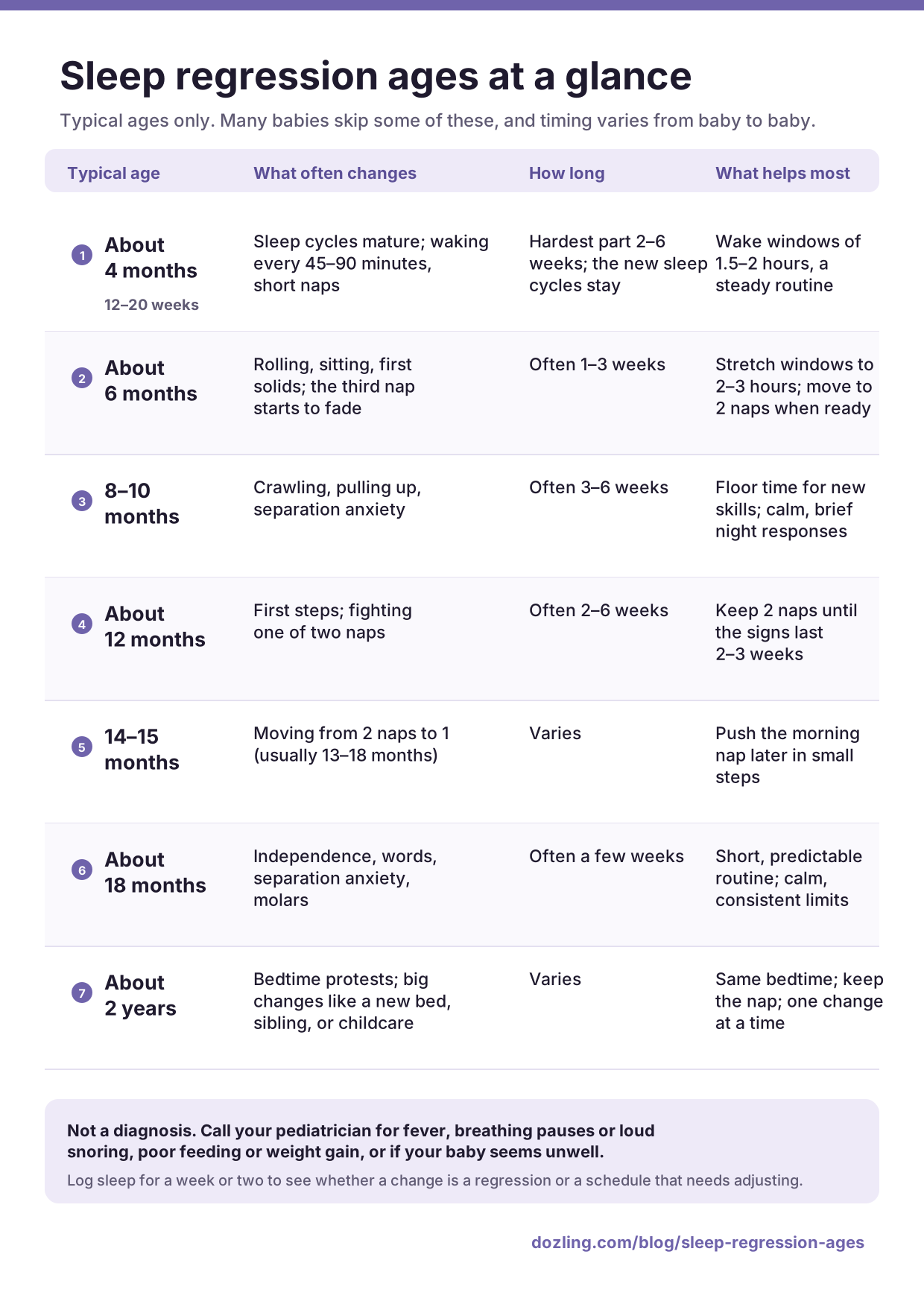
Download the printable chart (PDF): one page, sized for printing at home.
| Typical age | What often changes | How long | What helps most |
|---|---|---|---|
| About 4 months (12–20 weeks) | Sleep cycles mature; waking every 45–90 minutes, short naps | Hardest part 2–6 weeks; the new cycles stay | Wake windows of 1.5–2 hours, a steady routine |
| About 6 months | Rolling, sitting, first solids; the third nap fades | Often 1–3 weeks | Wake windows of 2–3 hours; move to 2 naps when ready |
| 8–10 months | Crawling, pulling up, separation anxiety | Often 3–6 weeks | Floor time for new skills; calm, brief night responses |
| About 12 months | First steps; fighting one of two naps | Often 2–6 weeks | Keep 2 naps until the signs last 2–3 weeks |
| 14–15 months | Moving from 2 naps to 1 (usually 13–18 months) | Varies | Push the morning nap later in small steps |
| About 18 months | Independence, new words, separation anxiety, molars | Often a few weeks | A short, predictable routine and calm limits |
| About 2 years | Bedtime protests; big changes like a new bed or sibling | Varies | Same bedtime, keep the nap, one change at a time |
The 4 Month Sleep Regression
This is the one almost every parent has heard of. Somewhere between about 12 and 20 weeks, sleep starts to cycle in lighter and deeper stages, with brief wake-ups between cycles. A baby who has always been fed or rocked fully to sleep may now need that same help at every cycle change, which can mean waking every 45 to 90 minutes.
What helps: wake windows of roughly 1.5 to 2 hours, a short and consistent bedtime routine, and practising putting your baby down drowsy but not fully asleep some of the time. The hardest phase usually eases within 2 to 6 weeks. Our 4 month sleep regression guide and 4 month old sleep schedule have sample days and more detail.
The 6 Month Sleep Regression
Not every specialist describes a separate 6 month regression, but many parents notice a wobble around this age. It often coincides with rolling both ways, learning to sit, starting solids, and the third nap beginning to fall apart.
What helps: stretch wake windows gradually toward 2 to 3 hours, and when the third nap keeps failing or pushes bedtime past 8:00 PM, move to two naps with an earlier bedtime for a week or two. Once your baby rolls, stop swaddling and use a sleep sack with free arms.
The 8 to 10 Month Sleep Regression
Between about 8 and 10 months, many babies learn to crawl and pull up, and separation anxiety becomes much stronger: your baby now knows you still exist when you leave the room, and objects loudly. The crawling study above found its clearest link in 7 and 8 month olds, where movement milestones explained 17% of the differences in night waking between babies.
What helps: lots of floor time during the day to practise crawling, pulling up, and getting back down; a calm, brief, predictable response at night; and not starting new sleep habits in a hurry that you would not want to keep. Our guide to the 8, 12 and 18 month sleep regressions goes deeper on this age.
The 12 Month Sleep Regression
Around the first birthday, many babies take their first steps and start resisting one of their two naps. It is tempting to drop to one nap straight away, but most babies make that move later, between about 13 and 18 months.
What helps: keep two naps until the signs of readiness last two to three weeks, not just a few bad days. Then move the morning nap later in small steps and use an earlier bedtime while your toddler adjusts. Our nap transitions guide shows how.
The 14 to 15 Month Wobble
Many toddlers who kept two naps through the first birthday make the move to one nap in this window, and the transition itself can cause a few weeks of short naps, early mornings, and overtired evenings. Parents often call this the 14 or 15 month regression.
What helps: a gradual shift of the single nap to around midday, a slightly earlier bedtime for the first weeks, and patience with the occasional two-nap day when your toddler clearly needs it.
The 18 Month Sleep Regression
At 18 months, toddlers want to decide things for themselves, understand far more than they can say, often go through another peak of separation anxiety, and may be cutting molars. Evenings can turn into negotiations.
What helps: a short routine done the same way every night, small choices inside it ("the blue pajamas or the green ones?"), and calm, consistent limits. Keep the nap: in a Swiss study that followed 493 children from birth, Iglowstein and colleagues (2003) found that 96% of children were still napping at 18 months.
The 2 Year Sleep Regression
Around the second birthday, sleep problems are more often linked to changes in a toddler's life, such as a move to a big bed, a new sibling, or starting childcare, and to a growing need for independence, than to a single developmental step. Bedtime stalling ("one more book") and leaving the bed are common.
What helps: keep bedtime at the same time every night, keep the nap for as long as your toddler needs it, and if you can, avoid making several big changes at once. The American Academy of Sleep Medicine recommends 11 to 14 hours of total sleep per 24 hours, including naps, for children aged 1 to 2 years, which is useful context when deciding whether bedtime is too late.
Regression or Something Else?
Before you put a rough patch down to a regression, rule out the usual alternatives:
- Illness or ear pain: fever, a runny nose, fussing when lying down, pulling at the ears.
- Teething: usually a few unsettled nights around a tooth coming through, not weeks. High fever is not a typical teething sign. See our teething and sleep guide.
- A schedule that no longer fits: wake windows that are too long or too short for your baby's age. Compare with our wake windows by age chart.
- Changes around your baby: travel, a new caregiver, starting childcare, or a clock change.
- Hunger: especially during growth spurts or after changes to feeding.
A week or two of sleep logs makes the difference much easier to see. A regression usually starts suddenly after a stable stretch; a schedule problem tends to creep in gradually.
How Long Do Sleep Regressions Last?
Most rough patches last somewhere between two and six weeks. The 4 month change is permanent, in the sense that the new sleep cycles stay, but the hardest part usually passes within that window as babies learn to link cycles. Later regressions tend to ease once a new skill is established or a nap transition is complete. If sleep has been clearly worse for more than six to eight weeks with no improvement, it is worth talking to your pediatrician and looking closely at the daily schedule.
Six Things That Help at Any Age
1. Keep wake windows right for your baby's age. An overtired baby finds it harder to fall asleep and wakes more often.
2. Keep the same bedtime routine. In a randomized study of 405 mothers and their babies and toddlers aged 7 to 36 months, Mindell and colleagues (2009) found that a consistent nightly routine reduced the time children took to fall asleep and how often they woke, within two weeks. Our bedtime routine by age guide has examples.
3. Make time to practise new skills during the day. The more crawling, standing, and walking happens on the floor, the less practising happens in the crib.
4. Respond at night calmly and briefly. Dim light, a quiet voice, few words. Sometimes a minute of waiting shows whether your baby will settle on their own.
5. Avoid stacking big changes. A new bed, weaning, starting childcare, and sleep training in the same week is a lot. Spread them out if you can.
6. Keep safe sleep non-negotiable. Back to sleep, a flat and firm surface, and nothing soft in the sleep space, as the American Academy of Pediatrics advises.
How to Use the Printable Chart
Print the one-page PDF and keep it somewhere you will see it at 3am, like the fridge or the nursery door. Some parents pencil in the month each window starts for their baby, so a rough week makes sense when it arrives. Pair it with a simple sleep log: when a hard stretch begins, the log tells you whether it started suddenly, which suggests a regression, or crept in over weeks, which suggests the schedule needs adjusting.
When to Talk to Your Pediatrician
A regression on its own is not a medical problem. Contact your pediatrician if your baby:
- has a fever, is vomiting, or seems unwell,
- snores loudly, has pauses in breathing, or breathes with effort during sleep,
- is feeding poorly or not gaining weight,
- has had clearly worse sleep for more than six to eight weeks with no improvement.
And if you are struggling with exhaustion or low mood, that deserves attention too. Ask your doctor for support.
How Dozling Helps Through Regressions
In the middle of a bad week, it is hard to tell whether things are really getting worse or just feel that way. Dozling logs naps and night sleep with one tap, tracks the current wake window, and shows weekly trends, so you can see when naps shorten and when sleep starts to settle again. The sleep insights view makes a sudden change easy to spot. It is a tool for noticing patterns, not a diagnosis.
The Bottom Line
Sleep regressions sound alarming, but they usually mean your baby is developing quickly. Most rough patches pass within a few weeks. Age-appropriate wake windows, a predictable routine, plenty of daytime practice, and patience with yourself help at every age.
Last updated: October 31, 2026. Sources: Scher and Cohen (2005), Iglowstein et al. (2003), Mindell et al. (2009), American Academy of Sleep Medicine consensus (Paruthi et al., 2016), American Academy of Pediatrics safe sleep guidance.
“A regression is a name for a hard stretch, not a diagnosis. Knowing the usual ages helps you stay calm; knowing your own baby helps you respond.”
— Dozling Editorial Team
Frequently Asked Questions
What are the sleep regression ages?
Does every baby have every sleep regression?
How long does a sleep regression last?
What is the hardest sleep regression?
Is there a printable sleep regression chart?
About the Editorial Team
Dozling Editorial Team
Editorial Team
The team behind Dozling prepares and maintains these general baby sleep guides using cited public sources. The content is informational and is not medical advice.
View all team articles